Sheet Metal Stamping: Processes, Equipment, and Practical Considerations

Sheet metal stamping is one of the most widely used manufacturing processes for producing high-volume metal components across industries such as automotive, aerospace, appliance, electronics, and construction. Despite its prevalence, many professionals outside the stamping shop floor have only a surface understanding of what the process entails, how different stamping operations work, and what practical factors determine success or failure. This guide provides a clear, operationally focused overview of sheet metal stamping for engineers, buyers, and production personnel.
What Is Sheet Metal Stamping
Sheet metal stamping is a cold-forming process that uses a press and a set of dies to transform flat metal sheets or coils into finished parts or intermediate shapes. The process involves placing the sheet metal between the die and the punch, then applying high force to shear, bend, stretch, or form the material into the desired configuration. Stamping operations are typically performed at room temperature, which preserves the material's mechanical properties while achieving tight dimensional tolerances and high surface quality.
Stamping is a high-speed, high-volume process capable of producing thousands of parts per hour with minimal operator intervention once the tooling is set up and running. The capital investment in presses and dies is substantial, but the per-part cost drops significantly at higher production volumes, making stamping the preferred choice for mass production of metal components.
The Stamping Press: The Heart of the Operation
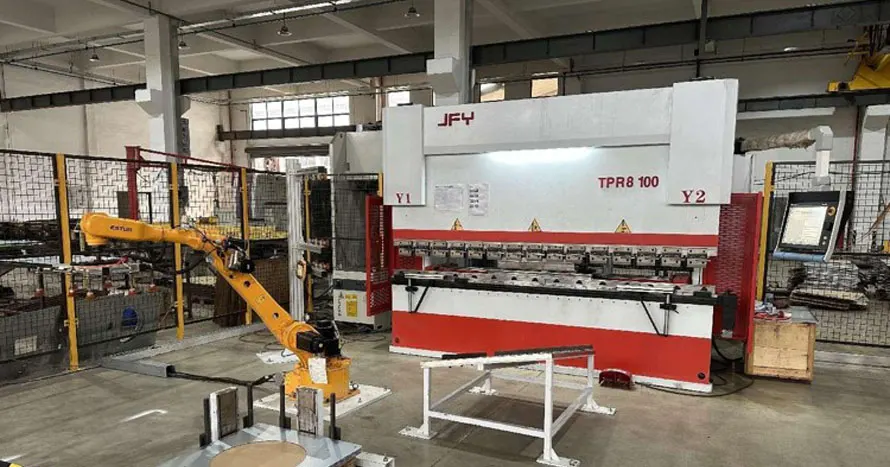
The press is the machine that delivers the force required for stamping operations. Press selection directly affects production rate, part quality, and tool life.
Mechanical Presses
Mechanical presses use a flywheel, clutch, and connecting rod mechanism to convert rotary motion into linear ram movement. They are characterized by high speed, consistent stroke length, and rapid cycling capability.
Advantages include high production speeds, consistent ram motion, and relatively lower initial cost compared to hydraulic presses of similar capacity. Disadvantages include fixed stroke length, limited energy adjustment, and higher noise levels.
Mechanical presses are best suited for blanking, piercing, and light forming operations where stroke length requirements are consistent and production volume justifies the high-speed capability.
Hydraulic Presses
Hydraulic presses use fluid pressure to drive the ram, offering full tonnage throughout the stroke and adjustable speed and pressure control.
Advantages include adjustable stroke length and speed, full tonnage delivery at any point in the stroke, overload protection, and smoother operation with lower noise. Disadvantages include slower cycle speeds compared to mechanical presses and higher energy consumption.
Hydraulic presses are preferred for deep drawing, coining, and applications requiring controlled forming speed or extended dwell time at bottom dead center.
Servo-Driven Presses
Servo presses use a direct-drive motor system to control ram motion with high precision, combining the speed of mechanical presses with the programmability of hydraulic systems.
Advantages include programmable ram motion profiles, energy efficiency, reduced noise, and the ability to optimize the motion curve for specific material and forming requirements. Disadvantages include higher initial cost and more complex control systems.
Servo presses are increasingly adopted for high-mix production environments where quick changeover and process flexibility are valued.
Major Stamping Operations
Stamping encompasses a wide range of individual operations, often combined in a single progressive die to produce a finished part in one press stroke.
Blanking
Blanking is the operation of cutting a flat shape from the sheet metal, producing a workpiece called a blank that will be further processed. The blank becomes the starting shape for subsequent forming or drawing operations.
Key considerations for blanking include punch-to-die clearance, which typically ranges from five to ten percent of material thickness per side, and the use of hold-down rings to prevent material lifting during cutting. Burr height increases as the cutting edges wear, signaling the need for tool maintenance.
Piercing
Piercing is the operation of cutting holes or openings in the sheet metal. The material removed during piercing is scrap, unlike blanking where the cut piece is the product.
Piercing requires careful attention to minimum hole diameter relative to material thickness. A general rule is that the hole diameter should be at least one to one and a half times the material thickness to avoid punch breakage. Smaller holes require special punch designs with increased strength and guidance.
Bending
Bending uses the punch to force the sheet metal into a die cavity, creating an angular displacement along a straight axis. Common bend shapes include V-bends, U-bends, and L-bends.
Successful bending depends on accurate bend allowance calculations to account for material springback. Springback is the elastic recovery of the material after bending, causing the final angle to be larger than the punch angle. Operators compensate by overbending the material beyond the desired final angle or using bottoming techniques that reduce springback by pressing the material into the die at the end of the stroke.
Drawing
Drawing transforms a flat blank into a three-dimensional shape by forcing the material to flow into a die cavity. The material is pulled rather than stretched, with the flange area supplying metal to the forming zone.
Deep drawing requires careful control of blank holding force, die radius, punch radius, and lubrication. Excessive blank holder force can cause tearing or cracking, while insufficient force leads to wrinkling in the flange area. The draw ratio, which relates blank diameter to punch diameter, determines the feasibility of the drawing operation without intermediate annealing steps.
Embossing
Embossing creates raised or recessed features on the sheet metal surface without changing the overall material thickness. This operation is used for decorative patterns, stiffening ribs, and functional features such as dimples for fastener clearance.
Embossing requires less tonnage than cutting operations but demands precise die matching to produce consistent feature height and definition.
Coining
Coining is a closed-die forming operation that applies high pressure to create precise, well-defined features with sharp corners and high dimensional accuracy. Unlike embossing, coining actually displaces material, resulting in a near-net-shape feature with no springback.
The coining process requires high tonnage due to the intense localized pressure and is used for applications such as coin production, bearing races, and precision alignment features.
Die Types and Configurations
The stamping die is the tooling that contains the punch, die button, and various auxiliary components. Die design and construction determine part quality, tool life, and production efficiency.
Simple Dies
Simple dies perform a single operation per press stroke. They are used for low-volume production or as individual stations in a larger process. Simple dies are relatively inexpensive to build and maintain but require multiple press setups to complete a finished part.
Compound Dies
Compound dies combine two or more operations at a single station. For example, a compound die can simultaneously blank and pierce a part in one press stroke. The part is produced complete with all holes in a single hit, ensuring accurate hole-to-edge location.
Compound dies are more complex and expensive than simple dies but reduce handling and setup time. They are well suited for medium-volume production where dimensional accuracy between features is critical.
Progressive Dies
Progressive dies have multiple stations arranged in sequence along a strip of material. As the strip advances through the die, each station performs a specific operation. The part reaches completion when it exits the last station.
Progressive dies are the most complex and expensive to build but offer the highest production efficiency for large volumes. They require precise strip feeding, piloting, and carrier strip design to maintain alignment across all stations. Typical applications include electronics components, automotive brackets, and appliance parts.
Transfer Dies
Transfer dies use individual die stations with separate units for each operation. A transfer mechanism moves the part from station to station. Unlike progressive dies, transfer dies use individual blanks rather than continuous strip material.
Transfer dies are suitable for large parts that cannot be formed in a progressive die due to size or material thickness. They also allow for more complex forming operations that cannot be performed in a single strip progression.
Practical Considerations for Production
Beyond the basic process knowledge, several operational factors determine stamping success on the shop floor.
Material Selection and Preparation
Sheet metal stamping uses a variety of materials, including mild steel, stainless steel, aluminum, copper, brass, and advanced high-strength steels. Each material has specific forming characteristics that affect die design, press selection, and lubrication requirements.
Material thickness, temper, and surface condition also play significant roles. Thicker materials require higher tonnage and more generous radii to avoid cracking. Harder tempers reduce forming limit but provide better springback control. Surface condition affects lubrication effectiveness and finished part appearance.
Lubrication Strategy
Proper lubrication is critical in stamping to reduce friction, dissipate heat, prevent galling, and extend tool life. The choice of lubricant depends on the material, operation type, and whether the part will undergo subsequent cleaning, painting, or welding.
Lubricant types include straight oils, oil-in-water emulsions, water-soluble synthetics, and dry film coatings. Application methods range from roller coating and spray application to drip feed systems.
Feed and Strip Handling
For progressive die operations, consistent strip feeding is essential. Feed accuracy determines station-to-station registration and final part dimensions. Common feed mechanisms include mechanical roll feeders, servo-driven roll feeders, and air feed systems.
Pilot pins in the die register the strip at each station, ensuring precise alignment despite slight feed variations. Strip guides and lifters prevent scratching and misalignment as the strip moves through the die.
Scrap Management
Scrap metal is generated during blanking and piercing operations. Effective scrap management includes proper scrap handling equipment, such as conveyors or scrap choppers, to prevent die damage from accumulated slugs. Sorting and recycling stamping scrap also contribute to cost recovery and sustainability goals.
Common Quality Issues and Solutions
Identifying and resolving quality problems is a daily reality in stamping operations.
Burrs
Burrs are raised edges or protrusions left on the part after cutting. They result from worn cutting edges, excessive clearance, or improper die alignment.
The primary solution is regrinding or replacing the punches and die buttons. Adjusting punch-to-die clearance and verifying alignment also reduces burr formation. For critical applications, secondary deburring operations such as tumbling or vibratory finishing may be necessary.
Cracking or Tearing
Cracks or tears occur during forming operations when the material exceeds its forming limit. Common causes include insufficient bend radius, excessive blank holder force, inadequate lubrication, or poor material quality.
Solutions include increasing die radii, reducing forming force, improving lubrication, using softer material tempers, or adding intermediate annealing steps.
Wrinkling
Wrinkles appear in the flange or sidewall of drawn parts when compressive stresses exceed the material's capacity. Wrinkling results from insufficient blank holder force, incorrect die geometry, or over-lubrication causing metal flow problems.
Increasing blank holder force, optimizing die radii, and adjusting lubrication quantity typically resolve wrinkling issues.
Springback
Springback is the dimensional change after forming due to elastic recovery. It results in parts that do not match the intended geometry.
Controlling springback requires overbending, bottoming, or coining operations to stress-relieve the material. Material properties and thickness variation also influence springback, requiring adjustments in the forming parameters.
Misregistration
Misregistration in progressive dies occurs when the strip positions incorrectly relative to the die stations. Causes include worn pilot pins, loose strip guides, or inconsistent feed pitch.
Maintaining pilot pins, checking strip guides, and verifying feed accuracy correct misregistration problems.
Safety Practices in Stamping Operations
Stamping presses present significant safety hazards due to high force, moving parts, and rapid cycling. Standard safety measures are non-negotiable in any stamping environment.
Light curtains and two-hand controls are the most common safety devices used to protect operator hands during loading and setup. Die guards and physical barriers prevent access to the point of operation during automatic cycling.
Lockout and tagout procedures must be followed before performing maintenance or die changeovers. All machine operators must receive comprehensive training on emergency stop procedures, setup protocols, and hazard recognition.
Sheet metal stamping is a mature yet continually evolving manufacturing process that combines high-speed production with tight dimensional accuracy. The fundamentals of press selection, die design, and process monitoring remain the foundation of successful stamping operations. Advances in servo press technology, tool coatings, and process simulation are expanding the capabilities of stamping to handle new materials and increasingly complex geometries. For shop floor personnel and engineers alike, understanding the practical aspects of blanking, piercing, bending, drawing, and related operations is essential for achieving consistent quality, minimizing downtime, and optimizing tool life.